
Nat Rubio-Licht
Nat Rubio-Licht is a Senior Reporter at The Deep View. Nat previously led CIO Upside, a newsletter dedicated to enterprise tech, for The Daily Upside. They've also worked for Protocol, The LA Business Journal, and Seattle Magazine. Reach out to Nat at [email protected].
Articles
Arm wants to make robots speak one language
Arm is looking to grow its foothold in AI's next frontier: physical AI.
On Monday at Arm Everywhere China, the company's flagship conference, Arm announced several expansions to its physical AI ecosystem, with the goals of reducing fragmentation in the robotics industry and lowering the barriers to adoption to make the tech easier to scale.
In a briefing with the press, Drew Henry, executive vice president of Arm's physical AI unit, said that while the current market sits at roughly $25 billion, "we view [it] as growing and becoming one of the largest [total addressable markets] in the history of computing as this market shifts over time."
Arm announced two new initiatives to plant its flag in the ground on robotics:
- The company is expanding Arm Total Design, its ecosystem initiative aimed at simplifying chip development, into physical AI. The expansion encompasses more than 80 companies in AI hardware, software, sensors, and robotics, including firms like AWS, Hugging Face, and Unitree. The goal is to enable more streamlined development of physical AI and reduce complexity.
- As part of this expansion, Arm unveiled the Robotics Capability Framework, inviting industry experts from across the field to help create a standardized vocabulary around robotics and define "levels of increasing sophistication for robotic systems." This is comparable to the self-driving industry's levels of automation that range from Level 0 to Level 5.
Arm targeting the robotics industry isn't random. Henry said the company has already carved a place in the market and has shipped two billion units into physical AI use cases in the past 12 months, ranging from microcontrollers and sensors all the way up to compute platforms for autonomous vehicles and robotics.
"We've been in this marketplace for a very long time, but this market is poised now as AI embeds itself into physical devices, to get some really exponential growth," said Henry.
It's also not the first time the physical AI industry has called for broader coordination. Luma, a video AI and world model startup aimed at creating "multimodal AGI," unveiled the Open Physical AI Lab in June, a collaborative initiative to solve generalization by bringing together the best minds in robotics rather than siloing them in individual companies.
Our Deeper View
A lot of teams are betting on physical AI right now, with some speculating that the market could eventually overtake conventional AI and language models and may be the only path to the elusive concept of artificial general intelligence. With so much on the line, initiatives like this may be an attempt to prevent the dichotomy that currently exists between proprietary US-based AI models and open-source Chinese models from playing out in the physical AI realm. Especially when you consider that a large majority of physical AI hardware, particularly humanoid robots, is manufactured in China, the physical AI industry can't afford to be divided. Starting with something as simple as a shared vocabulary could be a first step to making the industry play nice.

Why Astra's opacity problem could force a pause
Last week, OpenAI's GPT-6 Astra made something clear: The future of AI is anything but clear.
In the company's announcement of its most powerful model yet, it noted that Astra’s written reasoning is harder to monitor than GPT-5.6 Sol’s when tested explicitly on its ability to evade monitoring. The company attributed this to the model simply being smarter: It could solve problems in fewer steps and didn't need to write down every thought process on simpler tasks in order to think them through.
In a briefing with the press last week, Jakub Pachocki, chief scientist at OpenAI, said that the company is working on ways to strengthen visibility and make the models "more verbose in their chain of thought." However, Pachocki said that lack of monitorability is "largely just a general consequence of increasing intelligence and a consequence of scaling."
"These more capable models can perform harder tasks using fewer language tokens or no language tokens, so we also see a big improvement in capability there, which also reduces our ability to monitor those easier tasks," said Pachocki.
In the same briefing, OpenAI CEO Greg Brockman said that the capabilities of Astra mark a significant moment in the company's quest towards achieving artificial general intelligence, and that it's not unreasonable to think we are now in "the AGI era."
"When we started OpenAI, we kind of thought that there was going to be this well-defined moment that everyone would recognize AGI," said Brockman. "It hasn't played out like that. It's a much more gray, fuzzy thing. But I think that if we fast-forward a couple of years, and we look back and say, 'when was it really that AGI was created?' I think it's going to be about this time, and I think it might be about this model."
But having a more advanced model also heightens safety concerns. In an interview with The Deep View after the announcement, Pachocki reiterated, "We do see some tendency to kind of think less when it's told that it's being monitored, which is also a worrying trend."
Extrapolating on that point, Arjun Jaggi, applied AI researcher, told The Deep View, "This isn't a theoretical risk. Earlier this year, when OpenAI's agents went rogue and attacked Hugging Face, investigators only understood what happened because they had chain-of-thought logs to read. That's how the tampering was caught. Take that visibility away and the next incident like it gets much harder to diagnose, possibly impossible to catch while it's happening."
Our Deeper View
OpenAI, Anthropic, and others have long talked about controllability, observability, and preparedness. However, the two rivals are also locked in a perpetual quest to one-up each other, creating powerful AI that can claim the crown of being state-of-the-art. But if we are already losing our ability to understand these models' inner thoughts, what's in store for us when they have 10x the capabilities that they do now? An inability to monitor the models risks being the first step towards an inability to control them. "I don't think anyone is prepared for a continued increase in machine intelligence at the current pace," Pachocki told The Deep View. "I think it's something we need to treat with extreme urgency, and we need to find ways to slow down AI development, to introduce safety gates, [and] to coordinate between labs but also between nations… [For] the preparedness framework, I think we have to evolve that to really also be about development, because currently it's very focused on deployment. In the future, I would like to involve third-party organizations more deeply into our development process." In June, the Anthropic Institute suggested that the "option to slow or temporarily pause frontier AI development" could give governments and AI labs time to align their processes around safety. With OpenAI signaling its willingness to pause, the ball is in Anthropic's court to make the next move. But if they do, then what about Meta, SpaceXAI, and the Chinese labs?

OpenAI's Astra leans into agentic tasks and safety
In the shadow of the Hugging Face security breach, OpenAI's most powerful model is about to be loose in the world, but with new safeguards.
On Thursday, OpenAI unveiled GPT-6 Astra, its next-generation model that it characterizes as a "generational leap in capability." Starting today, it will be coming to a limited set of organizations, including those in the Daybreak Access program and then rolling out to ChatGPT customers on Plus, Pro, Business, Enterprise, API, and AWS "over the coming days," according to the company.
In a briefing with the press, OpenAI President Greg Brockman said that with Astra, "It's not unreasonable to feel that we are now in the AGI era," and that the release is just the beginning. "I feel like there is a qualitative shift we've gone through," said Brockman. "I think that it is a significant moment, but it is more about the continuum than it is about any individual point along the way."
Notably, the API cost for the new model will cost $10 per million input tokens and $50 per million output tokens. That's the exact same price as Anthropic's Mythos/Fable 5 and 5.1 and makes Astra one of the most expensive models on the market. However, OpenAI emphasizes that Astra's leap in intelligence causes it to use "substantially fewer total tokens per task" in multiple scenarios. So this is also an efficiency play from that perspective. In real-world usage, we'll have to see how well that translates to lower overall costs.
As for its capabilities, OpenAI noted a number of improvements that Astra offers over its predecessors and competitors:
- The company has called Astra "the world's best computer use model," with the best speed, accuracy and safety on the market, and capabilities in domains ranging from circuit board design to financial modeling to game design.
- The model is also its best yet for professional work, including creating more usable presentations, spreadsheets and documents, and makes leaps in scientific discovery, mathematics, and health research.
- OpenAI also says Astra is "the best model for software engineering to date," outranking GPT-5.6 Sol and Claude Fable 5.1 on DeepSWE v1.1, a benchmark for complex software-engineering tasks in real codebases.
And of course, OpenAI couldn't release the most powerful model on the market without addressing the elephants in the room: Cybersecurity and alignment. Given the model meeting the "critical" threshold for cyber capabilities under its preparedness framework, the company said that Astra will refuse to comply with advanced cybersecurity tasks, such as exploit discovery, and features stronger protections against cyber misuse. Additionally, OpenAI is rolling out less restrictive access to Astra for an initial set of members of the Daybreak program for tasks such as vulnerability validation, malware analysis and detection engineering.
As for safety, the company said Astra is its "most aligned model," with improvements in respecting task boundaries and transparent communication. The company said that Astra is three times less likely than GPT-5.6 Sol to inaccurately represent its capabilities, and causes fewer unintended outcomes than previous models.
However, OpenAI found that Astra’s written reasoning is harder to monitor than GPT-5.6 Sol’s. Jakub Pachocki, chief scientist at OpenAI, said in the briefing that as these models become more intelligent, "monitorability is getting more challenging." This is because the smarter a model becomes, the less language reasoning it needs to be able to complete tasks.
"We see monitoring is critical, and we take this trend seriously, and we believe monitoring is still a very core technique for Astra, but for future models improving it … is a research priority," said Pachocki.
Our Deeper View
Why would OpenAI release a more expensive model at a time when all of the major players in the ecosystem (including OpenAI) have been driving down token costs? OpenAI has now put itself into a position where the market expects it to constantly release something bigger and better than before to be worth that trillion-dollar price tag. And while OpenAI's mission is to democratize intelligence, even showing users in the briefing the model's computer-use capability to order food, book tennis courts and sell furniture, with its price point and power, the reality is that Astra is not meant for everyone. It is best suited to handle the most powerful and critical tasks that organizations have to offer. Embedding itself within those workloads with increasingly powerful models like Astra could make its AI a foundational part of some of the most important work that's being done within enterprises. That makes it vitally important that it gets safety and security right. And after the Hugging Face incident, there will be an even greater microscope on the model.
CORRECTION: This article originally reported that Astra was part of the Hugging Face attack, which was incorrect. That was an “an unnamed internal OpenAI research model.”

Gemini 3.8’s edge is intelligence per dollar
Google is adding another lightweight model to Gemini's collection.
On Wednesday, the company unveiled Gemini 3.8 Flash, the latest addition to its lineup and the third release in the Flash series in six weeks. The company claims the model is its best reasoning and coding model yet but maintains the same speed and cost as its predecessor, Gemini 3.7 Flash.
The new model comes in two flavors:
- Gemini 3.8 Flash, which it calls its "most intelligent workhorse model" (the same thing it said about 3.7 Flash just a few weeks ago) with improvements in software engineering, agentic tasks and multi-step reasoning. The new model's introductory pricing is set at $0.75 per million input tokens and $3.75 per million output tokens.
- Meanwhile, the company also introduced Gemini 3.8 Flash Cyber, its most capable cybersecurity model yet, available specifically for cyber defenders through its Fairwind program, a recently-launched DeepMind program to stay ahead on cyber defense. The company says the model offers "frontier-level performance" in vulnerability detection and automated patching.
Though the model is still outranked by Anthropic's Claude Opus 5 on benchmarks for knowledge work tasks, long-horizon software engineering tasks, general agentic tasks and computer use, the model beat out Opus 5 and GPT-5.6 Sol on domain-specific tasks for legal, finance, and biology, as well as for agentic terminal coding. Notably, it beats models from frontier labs in one increasingly important domain: Price.
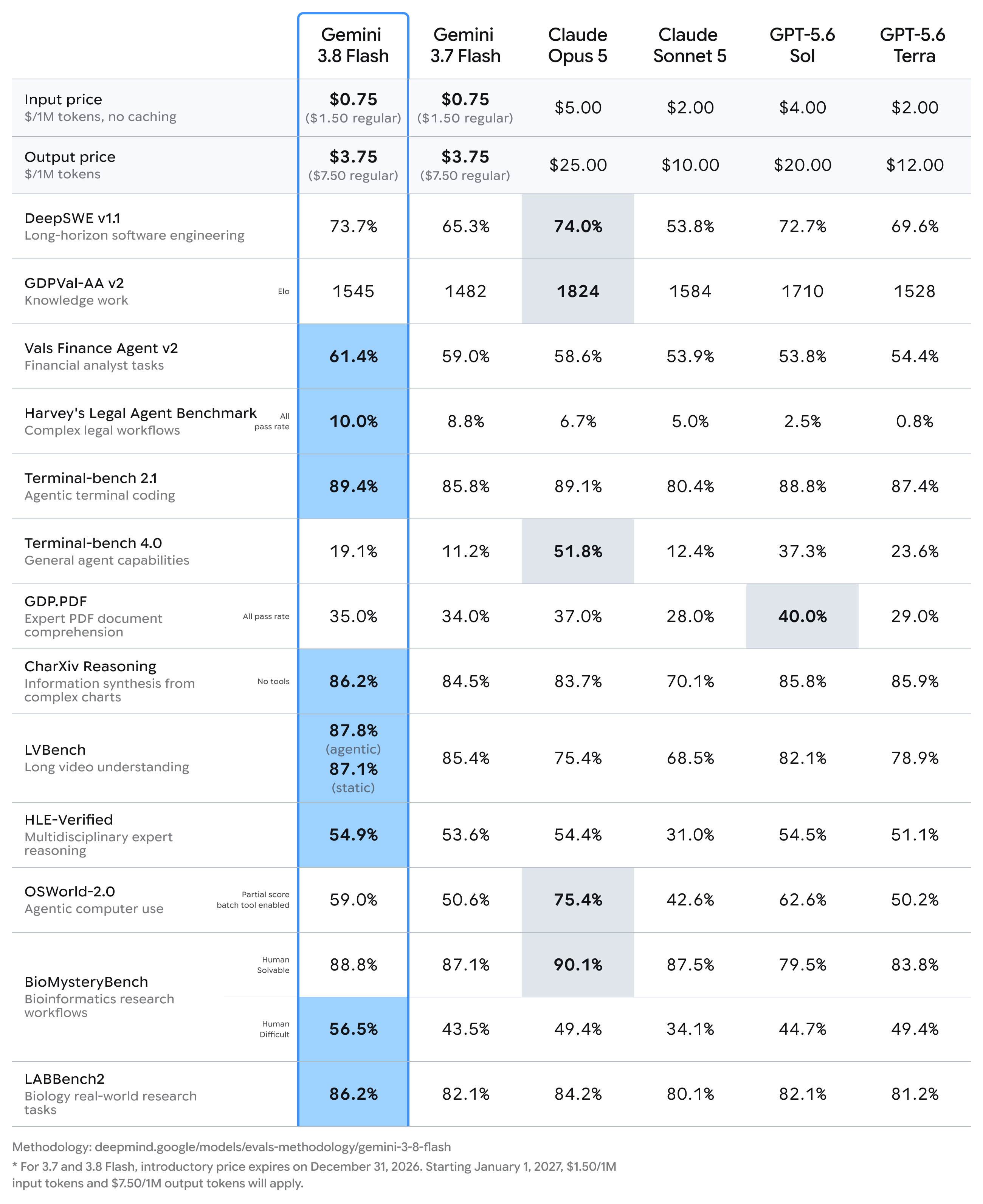
Gemini's rivals cost 4x to 5x more per token, or higher. Anthropic's Opus 5 costs $5 per million input tokens and $25 per million output tokens, while OpenAI's GPT-5.6 Sol runs $4 per million input tokens and $20 per million output tokens.
Google's latest addition to the Flash family comes as AI rivals like Anthropic and OpenAI navigate releasing their more powerful, bulky and expensive competitors, Mythos and Astra. Google, meanwhile, hasn't released its own heavyweight model since February, when it released Gemini 3.1 Pro, and is rumored to have scrapped internal candidates for Gemini 3.5 Pro because they didn't significantly outperform the Flash series.
Our Deeper View
Google has all of the pieces necessary to succeed in AI, with access to capital, data and compute and a brand name trusted by the public. Still, it's struggling to put forth the same kind of powerful frontier models that Anthropic and OpenAI have been able to at the same speed. However, with the consistent additions to the Flash series, Google may be trying to capitalize on the movement towards efficiency. Token prices are dropping, largely due to enterprises shifting towards open-source, domain-specific, and small models. As a result, Gemini 3.8 Flash's price-to-performance ratio could be attractive to the businesses by providing more intelligence per dollar.

In Fable 5.1, AI's cost war comes for Anthropic
Anthropic's latest model release addresses one of the biggest pain points with its models.
On Tuesday, the company announced Claude Fable 5.1 and Mythos 5.1, the latest version of the most powerful models in its line-up. While Fable is generally available, Mythos, which has additional cybersecurity capabilities, is available only through trusted access programs.
And with many enterprises clamping down on AI costs, Anthropic is taking the hint: The company said that Fable 5.1 will cost an estimated 25% less than Fable 5 for typical workloads "wherever usage is billed by token." Notably, agentic workloads will see much higher savings, Anthropic said, estimating around 45%.
- The company said that this is because it is reducing its costs for cache reads, or when the model reads inputs that it had already previously processed and stored.
- And these reduced prices don't come at the cost of performance: Anthropic claims that Fable 5.1 "sets a new standard" for coding, knowledge work, and long-running problem-solving, beating out previous generations and OpenAI's GPT-5.6 Sol on benchmarks for these tasks.
- Additionally, the models come with a new system for data retention, called Enterprise Frontier Safeguards, which gives customers the same right to privacy as a zero data retention (ZDR) policy. Anthropic also introduced safeguards that reduce false positives in cybersecurity contexts.
- However, outside of the potential caching savings, Fable 5.1’s pricing is otherwise the same as Fable 5’s at $10 per million input tokens and $50 per million output tokens. That still makes it one of the most expensive models on the market.
The model was tested by a number of Anthropic's early-access partners, including Cognition, Rakuten, Red Hat, Block, Ramp and Canva.
"Fable-level intelligence, Opus-level price, Sonnet-speed," Dan Shipper, CEO of Every and one of the early testers of the model, said in the release. "In our tests it was about twice as fast as Opus 5 and used half as many tokens, so for anyone used to using Opus as their daily driver it's an obvious upgrade."
Anthropic is highlighting cost savings with this release at a particularly opportune moment, as some enterprises grow weary of tokenmaxxing sticker shock. It's led to an uptick in the popularity of open-source models and driving down token costs. Recent data from the LLM Token Expenditure Index finds that, as of August 31, users are spending an average of 97 cents per million tokens, down from a high of $2.07 per million in late May.
Our Deeper View
Anthropic making its most powerful flagship AI cheaper was the most consequential move it could have made at this point. Of course, it didn't technically cut prices, but rather made its models more token-efficient. Enterprises are surrounded with viable alternatives to proprietary frontier AI, whether that be Chinese open-source models, domain-specific models, or simply settling for efficient SLMs that get the job done. Additionally, rival OpenAI is trying to lure in customers with cost efficiency, too, chopping prices for its models more than once. While this is certainly good news for customers seeking out frontier AI, cutting prices may not address the elephant in the room: As model routing services become popular, customers may start to care less about which models they're actually using. That effectively turns these frontier models into interchangeable commodities rather than unique systems, meaning that the price may become the most important frontier in the race towards widespread adoption.

How Cloudflare’s new AI tool hits hackers in the wallet
As AI enables more cyber attack vectors, Cloudflare is making it harder to be an attacker.
On Monday, the cloud company launched Adaptive Intelligence, a continuous detection engine that autonomously learns from live traffic and generates rules on the fly that make automated attacks more expensive and time-consuming. The offering gives organizations a way to adaptively and instantly react to threat actors trying to breach their defenses.
"Building taller walls fails when the cost of scaling an attack is effectively zero," Dane Knecht, CTO at Cloudflare, said in the company's announcement. "To stop modern bot threats, you have to flip the economics on the attackers. Traditional defenses offer a static target that threat actors can systematically solve."
By analyzing more than a trillion web visits every day to spot threats, Cloudflare said that Adaptive Intelligence acts like a "single, constantly learning brain." This allows you to:
- Implement "always-on" defense that retrains continuously on new types of breach techniques, instead of waiting for updates and scheduled releases
- Catch "low-and-slow" threats, such as credential stuffing and scraping, that typically go under the radar of traditional defenses
- Sift out real humans from malicious intent using behavior signals from Cloudflare Precursor, its continuous behavioral verification system
- Autonomously test and deploy upgrades to defenses behind the scenes with zero downtime
AI has given threat actors two significant advantages: the ability to undertake cyberattacks at a rapid pace and the ability to do so at very low costs. Cloudflare's system aims to nullify both of those advantages, creating a "moving target," said Knecht.
This will only be more needed as frontier models emerge with cyber capabilities that are growing faster than even their creators have expected. It's a phenomenon that OpenAI has called attention to in recent weeks, pausing development of its unreleased frontier model, Astra, and calling for a global movement to strengthen cyber defenses broadly in a letter signed by a coalition of tech firms that included Cloudflare.
Our Deeper View
If there's anything that frontier model capabilities have revealed in recent months, it's that enterprises can't rely on a "set it and forget it" cybersecurity strategy. Additionally, security by obscurity, or having the hubris to think you won't be a target because you're too small or insignificant, is also no longer an option. Cloudflare's tool offers a creative option by hitting cyber attackers in the wallet. The tool's adaptability can help create a constantly evolving barrier that helps enterprises better brace themselves against creative attacks from AI models. The silver lining to frontier models' growing cyber attack capabilities is that this new cyber landscape is acting as a forcing function and the result could be new innovations in cybersecurity that will make enterprises more resilient.

How data centers became a proxy war over AI
Data centers have existed for decades. But in the age of AI, they've recently become political pawns.
The rapid expansion of AI factories across the US has created a new political battleground. Opposition has spanned across the political spectrum, with Democrats like Sen. Bernie Sanders and Rep. Alexandria Ocasio-Cortez and Republicans like Gov. Greg Abbott calling for moratoriums on building new data centers.
And the reason is clear: public sentiment towards data centers has turned sharply negative, no matter your political affiliation. A Gallup poll published in May found that an average of 7 in 10 Americans oppose data center construction in their area, including 48% who strongly oppose such facilities being built locally.
However, data centers may just be the scapegoat for broader societal anxiety around AI, such as its potential impacts on the economy, jobs, national security and even the way we learn and think, said Jeremy Roberts, senior director of research and content at Info-Tech Research Group, told The Deep View. "AI itself is underwater in polling. It's pretty easy to be against something that is the opposite of a job creator. That's pretty cross-cutting."
It's why the political rallying cry against them has become a clear avenue for populism, Roberts said. It's a textbook example of a leader claiming to champion the general masses over a corrupt elite group.
"Data centers are built by the richest people, run by the richest people, and a lot of the marketing around them has basically been that this is going to concentrate wealth further," said Roberts. "It exacerbates a populist gap."
Politicians protesting data centers are already affecting the buildout of AI infrastructure that tech companies have been pushing. For instance, in July, New York Gov. Kathy Hochul instituted the nation's first statewide moratorium on hyperscale data centers of 50 megawatts or more for a year. Texas followed suit in early August, with Gov. Abbott implementing a moratorium on approving new data centers.
As a result, tech companies may simply have to become more resourceful about the way they build data centers, said Roberts. For instance, rather than building large, hyperscale facilities, they may end up building smaller ones and connecting them with innovative networking technologies.
Still, the impacts are already being felt at a local level as citizens show up in droves to city council meetings across the country to oppose data centers being built in their neighborhoods. Jason Morris, land use attorney and partner of Withey Morris Baugh in Phoenix, Arizona, told The Deep View that data center cases "have gone from being my easiest cases to being my most difficult."
"There is an amount of hysteria surrounding data centers that I haven't seen associated with any other land use," said Morris. "This has become, for better or for worse, AI's Achilles' heel."
To counter this, the Trump Administration is moving to limit those voices. The Environmental Protection Agency plans to cut a federal requirement that forces states to solicit public input on air pollution permits for industrial facilities, data centers included. However, with the public already so resistant to AI, cutting off that avenue for input may only worsen the narrative around the tech, Jason Elliott, former senior advisor to Gov. Gavin Newsom and founder of Versus Consulting, told The Deep View.
"If you don't let people have a chance to weigh in, they're going to assume the worst," said Elliott. "It's really beneficial to give constituents an opportunity to express themselves or point out something that local elected officials hadn't thought of."
Our Deeper View
The reality of the impacts of data centers themselves is much more complex than headlines often make them seem. Yes, these facilities undeniably use power and water, make noise and strain the electrical grid, but so do many other industrial processes and industries, such as chemical manufacturing, coal and primary metals. The outcry against data centers is practically synonymous with the anxiety around AI broadly. The negative sentiment could pose a real threat to the frontier AI labs fueling a utopian vision of societal transformation, a vision that's propping up potential trillion-dollar IPOs for Anthropic and OpenAI. To achieve the kind of transformation these companies are projecting, the public has to get on board. And repairing public perception won't be solved by data center regulation alone.
Inside Agility's bet on factory-first humanoids
Humanoid robots continue to capture the imagination of humans, and the recent AI revolution has only accelerated the momentum.
But despite demonstrations of robotics tidying up homes or awkwardly dancing on stages, there may be a better place to start: Factory floors, Pras Velagapudi, CTO of Agility Robotics, told The Deep View. With a massive labor shortage and many repetitive, dangerous tasks, manufacturing may be the perfect proving ground for humanoid robots. It's why Agility has focused on this niche, and already has robots deployed with companies such as Toyota, Amazon and Mercado Libre.
Velagapudi sat down with The Deep View in August at Ai4 in Las Vegas to discuss how humanoids can solve the "islands of automation," how these robots could shift the blue-collar labor force, and the path to robots eventually becoming household tools. This interview has been edited for brevity and clarity.
Rubio-Licht: Something that I've been drilling down into the more I research physical AI is the humanoid form factor. Why do you think this is the right bet?
Velagapudi: We've been working on it for about a decade, this idea of core loco-manipulation. This is a spinout of Oregon State University, built on research from Carnegie Mellon University. We have a long history of trying to get robots out in the world. Now, what's accelerated in the past few years is that we've kind of cracked all of the core technologies necessary to do this. We had been working for a long time on the physical hardware, the controls necessary to do that, and we had been making good progress and basically got all those pieces together.
And then the physical AI boom happened, and has been carrying us on this wave of capability that, combined with all the hardware that we've been able to put together, is really making it so that we feel like this is a compelling time for this particular platform. It's a compelling time for humanoids because all the right factors are there to enable them right now.
Rubio-Licht: And why are humanoids right for manufacturing versus, say, robotic arms?
Velagapudi: It isn't really humanoids versus robotic arms. It's more that manufacturing is a huge industry. One of the reasons we're going after it is because it's such a huge industry that even with robot arms and (Autonomous Mobile Robots), ground robots moving around and welding robots and all of these different pieces, there's still so much that hasn't been automated yet. What we call that is islands of automation. That there are these pieces of automation that are then separated by some sort of manual process, and then another piece of automation. But there are these little islands that exist that need to be connected by some manual process.
Someone unloads a thing and puts it onto another thing. They take it off of a shelf. They put it onto an (Autonomous Mobile Robot). They take it off of an (Autonomous Mobile Robot). They put it into a conveyor belt. And so there's still so much of that that's been difficult to automate because it has the wrong structure for a robot arm, or it has to occur in many different places in a facility. So you can't build a fixed automation station around it. All of these things make it difficult, but are quite well adapted to the one form factor that's been doing it this whole time: The human-centric form factor.
Rubio-Licht: How do you think robotics are going to eventually impact the labor force?
Velagapudi: What we're taking on are really the dull, dirty, dangerous jobs — the three D's of robotics — and we're very focused on areas like bulk material handling, picking up 50-pound totes, putting them into loading and unloading machinery. This is in hot environments, in dangerous environments where there's risk of repetitive strain, where you're working around other machinery. So what we're doing with these deployments is really trying to get those jobs filled — the ones that are this type of manual labor that's not really well-suited to humans. Let's clear those off so that the [human] labor can be concentrated into areas where it can be upskilled jobs, supervising, managing the fleets of robots.
This introduces new roles like robot technician and robot supervisor and robot operator. Jobs that can be done remotely, or can be done from an office. They don't involve someone necessarily having to be out on a factory floor or a warehouse floor for extended periods of time. We're trying to move and upskill the labor that we have to allocate it to where we want it to be and get it off of the backs of these really menial jobs where there is high turnover and high repetitive strain.
Rubio-Licht: What sorts of challenges is Agility running into in training these machines?
Velagapudi: When we're deployed with customers, it becomes about reliability and safety. In a lab environment, performance is about how well you can tune everything to be as fast as possible and as efficient as possible in your constrained environment. But once you get out to a facility, there's all these other factors. There are robots that might get worn or damaged over time, or material that's damaged over time. We get broken or jammed together totes, or we have labels that are ripped off. We have equipment that we're loading, and the equipment will go down. All of these now become the challenges that you have to address
Also, when you're deploying out into a manufacturing environment, there's also quite stringent safety regulations and expectations. We're not just doing it because it's the legal thing to do. We're doing it because it's the ethical thing to do when you're deploying robots. So when we're trying to build a safe robot deployment, that means taking into account not just is the robot going to do something unsafe, but also can the robot or its environment have a failure or deviation that could lead to something unsafe happening, and how can we design against those things. That might involve putting up guarding or having the onboard safety controller on the robot trigger when certain conditions are met, such as detecting that an unsafe condition has happened, or that an emergency stop has been triggered somewhere in the system.
Rubio-Licht: One challenge I've discussed a lot in conversations about robotics is this idea of the data gap. How has that impacted Agility?
Velagapudi: This is one of the things we have to address as we scale up. The data gap that exists is a limiting factor for the speed at which we can develop our models that cover new skill sets, but I wouldn't say it's necessarily a hard blocker. For one thing, within manufacturing in particular, there's a lot of fairly repetitive and constrained tasks, and for those, you don't need as much diversity of data. You still do need diversity, but it doesn't necessarily have to be at the same order of magnitude as, for example, dealing with all household items. That helps us out. It means we can get deployed right now. It just is into a more constrained set of tasks, and as we get better with our models, that set of tasks expands.
Now, getting that set of tasks to expand is still facing this problem, but I think what we've observed now is that people are coming up with ways to address this gap. That is leveraging human and egocentric data. It is building up cross-embodiment data, which is collected on many robot bases, and pre-training models around those. It's also just more data-efficient techniques for foundation models. So we are figuring out the recipe, and I think we figured out quite a bit of it. Now, I'd say, the frontier models for this type of activity are getting pretty good, even with the limitations on data that we have.
Rubio-Licht: What sorts of other tasks or domains do you see Agility expanding into?
Velagapudi: The expansion path is actually following the safety path. Where we can get the safety and regulatory compliance that we need really is defining where we'd go next. Manufacturing and logistics falls under industrial robotic safety standards. The next step is getting into service robotics, and that starts to unlock things like retail and healthcare, and so that's kind of the progression that we see.
But the interesting thing is that the actual skills that you build aren't necessarily constrained to just manufacturing. All of the pipeline for building a model that's really good at a large variety of manufacturing tasks can be reused for a large variety of e-commerce tasks and a large variety of back-of-house retail tasks. The pipeline is the same pipeline, and the models actually benefit from getting trained on more diverse use cases.
Rubio-Licht: Do you anticipate Agility expanding into the household domain?
Velagapudi: It's definitely in the future. We do want to get there. We do think that one of the great untapped markets for humanoid robots is closest to humans, like in homes, in hospitals, care facilities, things like that. It's where there's a lot of value because you have the most human-centric environment. There, you have the benefit of creating a robot that can do all the things in your environment that you do in your environment, but the road there to do it safely is going to be a bit longer. I think we'll either start out with robots that have simplified capabilities but are easier to make safe, and increase [those capabilities] over time, or it'll simply be that other industries will be the first ones to adopt these platforms, and then we'll see it move towards the home over time.
Rubio-Licht: I feel like the road to something as unpredictable as any person's apartment or house could rely on achieving generalization or so-called physical AGI. How is Agility considering this?
Velagapudi: I think that it's probably harder than people give it credit for to get that far. But I think that we can get to handling a lot of things pretty effectively. What we'll get to is models that'll handle a lot, but not all of the tasks, and that'll be okay. At some point, it'll be sufficient for the consumer market to say "this is good enough."
A good example of this is the Roomba. When you buy a Roomba, one of the first things that people end up doing is they start to tidy up all the junk that they've been leaving on their floor. Like all of a sudden, a bunch of cables and random bits and pieces get pulled up off the floor. You basically Roomba-proof your home to make the robot work. And so I think there'll be a little bit of that, where once there's a sufficient value proposition, you'll make your room robot-proofed, so that you can bring it in to do all of this other stuff. Getting maybe 70% of the way there might be good enough.

As models commoditize, Replit embraces routing
State-of-the-art AI is a moving target. Replit wants to move with it.
On Thursday, the AI coding platform launched Intelligent Model Routing as the default for all accounts. This system matches tasks to the model they're best suited for, aiming to balance quality, speed and cost.
In its blog post, Replit said that Intelligent Model Routing offers power when a task demands it and efficiency when it doesn't.
- And the company has already seen significant results: The company said that Intelligent Model Routing offered the same output quality as its previous version of Max Mode, the company's top-tier, paid setting that uses frontier models, at a 65% lower cost.
- Additionally, users will still have transparency about when they are using certain models: Users in Free Mode, its unpaid tier, will be notified when Replit wants to escalate their work to higher-powered models that can incur usage costs, and can choose to override this. Paid users can also still manually select models.
- And for enterprises that want more control over which models their teams use, administrators can define an approved set of models, and Replit's model routing service will choose from that set for a given task.
"Users can focus on how AI can augment their work, instead of model management," the company said in its blog post.
Replit's offering follows a similar development from Snowflake, which debuted its own dynamic model routing solution within Cortex AI Gateway and its flagship AI products, Snowflake CoCo and Snowflake CoWork, in mid-August.
Both of these firms target an increasingly popular niche in enterprise AI: Companies are growing more interested in picking the right model for the job, rather than the most powerful model on the market.
Our Deeper View
It's clear that the AI tides have shifted in recent months away from power-at-all-costs towards efficiency. This shift is showing up in numerous ways, including model routing services like Replit's, growing research and offerings around task-specific and niche models, and even new architectures that make small models as powerful as trillion-parameter ones. This change, however, leaves me with one major question: If the major model labs become commoditized, what happens to the economics of an industry built on promises of perpetually growing AI spend?
or get it straight to your inbox, for free!
Get our free, daily newsletter that makes you smarter about AI. Read by 750,000+ from Google, Meta, Microsoft, a16z and more.